Building 9 Blog
Expert tips, renovation guides, and practical home improvement advice for your next project.
What Are the Best Bathroom Faucets from China?
Table of Contents
- Types of Bathroom Faucets Commonly Manufactured in China
- Key Features to Evaluate Before Choosing a Chinese Faucet
- Leading Chinese Bathroom Faucet Brands and Manufacturers
- Quality Standards, Materials, and Certification Requirements
- How to Select the Best Chinese Bathroom Faucet for Your Needs
- FAQS
- Conclusion
- Related Posts
Choosing the best Bathroom Faucets from China requires more than comparing prices or polished product photos. China has a broad manufacturing network, from small workshops to advanced factories producing brass, stainless steel, and ceramic-cartridge models. Quality can vary sharply. That matters.
A useful design principle comes from Ludwig Mies van der Rohe, a respected authority whose ideas still influence bathroom product design: “Less is more.” For faucets, this means clean shapes should support practical performance, not hide weak construction. Buyers should examine the faucet body material, cartridge durability, surface plating, aerator design, connection size, and warranty terms. A heavy-looking faucet is not always a reliable one.
Experience also reveals uncomfortable details. Product samples may perform well while later batches show inconsistent polishing or loose handles. Online descriptions can be incomplete. Therefore, responsible buyers should request material reports, pressure-testing records, water-efficiency data, and clear inspection procedures. Certifications must match the destination market, because approval requirements differ across countries. A reputable Chinese supplier should communicate openly about lead content, coating thickness, replacement parts, and after-sales support.
There is no universal winner.
This guide will compare Chinese Bathroom Faucets through practical criteria, including construction, usability, design, compliance, factory capability, and long-term value. It will also consider OEM and private-label buyers who need stable production, not attractive samples alone. Some conclusions may remain imperfect, because supplier performance can change over time. That uncertainty deserves attention. The strongest choice is usually not the cheapest faucet, but the one supported by verifiable specifications, consistent quality control, and dependable communication.
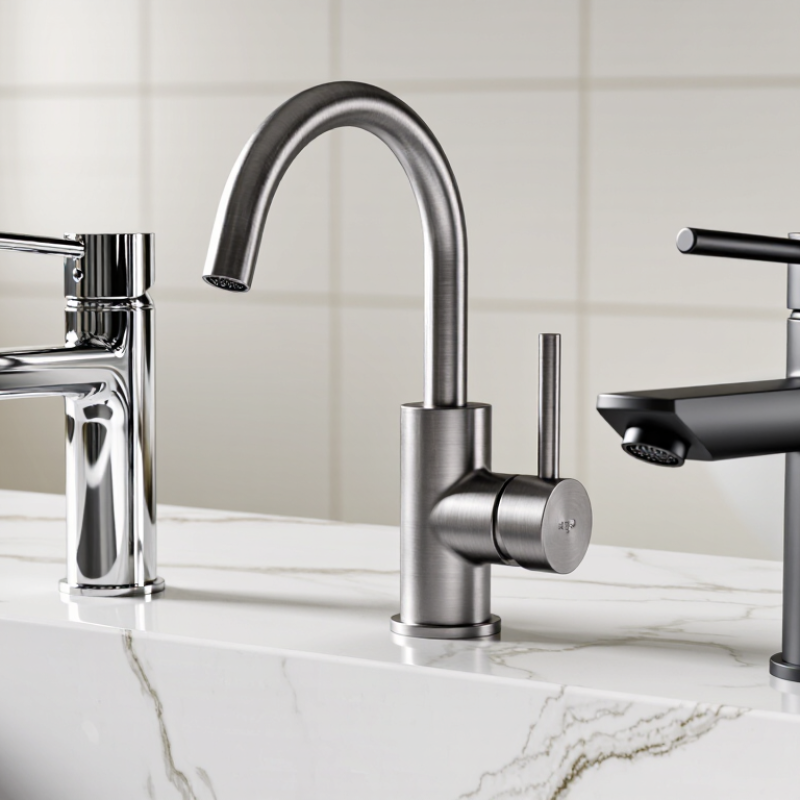
Types of Bathroom Faucets Commonly Manufactured in China
Bathroom faucet production in China covers several practical designs. Single-hole faucets suit compact basins and modern hotel bathrooms. Centerset models fit standard three-hole vanity basins. Widespread faucets use separate handles and a spout. They offer flexible spacing on larger countertops.
Wall-mounted faucets create a clean, open basin area. They require accurate pipe placement behind the wall.
Tub and shower faucets often include diverters, hand showers, or thermostatic controls. These products need careful testing because pressure changes can affect temperature stability. That matters.
Manufacturers commonly use brass, stainless steel, or zinc alloy for different price levels. Brass bodies usually provide solid weight and machining strength. Stainless steel can resist corrosion, especially in humid bathrooms. Ceramic cartridges support smooth handle movement and reduce dripping. Many models also use aerators that limit water flow without making the stream feel weak.
When evaluating the best bathroom faucets from China, inspect more than the finish. Check cartridge durability, thread accuracy, coating consistency, and spare-part availability. A sample may look excellent, yet internal components can tell another story. I would request pressure, leakage, salt-spray, and cycle-test records before approving a production order. Certification requirements also vary by destination, so documentation must match the intended market. A small installation mistake can cause a large complaint. Even experienced buyers sometimes focus too heavily on appearance. Function deserves equal attention.
Key Features to Evaluate Before Choosing a Chinese Faucet
What Are the Best Bathroom Faucets from China?
When evaluating bathroom faucets from China, look beyond photographs and low quoted prices. In practical inspections, check the body material, cartridge, aerator, and connection threads. Brass offers dependable weight, while stainless steel can resist corrosion in humid rooms. Ask for material documentation, not vague promises. Some finishes look excellent under showroom lights but reveal uneven plating near the spout. Run water through a sample and watch for spray, noise, dripping, and temperature changes. Small defects matter. Confirm the faucet’s working pressure range and installation dimensions before ordering. Measurements should match your basin, countertop thickness, and existing water lines. Also verify testing records and certifications accepted in your destination market. Requirements differ by country, so copied certificates may not prove compliance.
Tips: Request a complete specification sheet, installation drawing, sample video, and written warranty. Ask how replacement cartridges and aerators are supplied. A reliable supplier should explain coverage, response times, and exclusions clearly. Keep every promise in writing.
For commercial projects, consistency is as important as appearance. Order several samples and compare their color, handle movement, and water flow. My early assumption was wrong: heavier does not always mean better. Weight alone cannot confirm material quality or long-term performance. Check machining around the handle base and underside, where poor finishing is easier to hide. A smooth quarter-turn handle usually feels more controlled than a loose, stiff one. Before committing, test the faucet with your actual water pressure. That small step can expose problems that catalog images never show.
Leading Chinese Bathroom Faucet Brands and Manufacturers
What Are the Best Bathroom Faucets from China?
Leading Chinese Bathroom Faucet Brands and Manufacturers
The best Chinese bathroom faucets usually come from manufacturers with strong engineering, stable production, and clear quality controls. Many factories support OEM and ODM projects, allowing buyers to adjust handle shapes, finishes, cartridges, and packaging. Experienced suppliers should provide material details, product drawings, test reports, and sample approval before mass production. Brass bodies, ceramic cartridges, and corrosion-resistant finishes are common choices for long-term bathroom use.
A factory visit can reveal useful details. Look for organized assembly lines, labeled components, water-pressure testing, and clean storage areas. Reliable manufacturers also explain production limits instead of promising everything. That matters. A polished catalog does not always prove consistent quality. I have seen attractive samples differ slightly from later batches, so batch inspection remains worthwhile. Certifications should be checked through independent sources and matched with the exact model, not just the factory name.
Tips: Request two or three samples from different production batches. Check handle movement, water flow, surface coating, thread accuracy, and hidden leakage. Ask how replacement cartridges and spare parts are supplied. Compare warranty terms carefully, because vague promises can create problems later. A cheaper faucet may save money initially, yet uneven plating or weak internal parts can increase service costs. Leave room for improvement; even a dependable manufacturer may need clearer drawings, tighter inspections, or better packaging for your market.
What Are the Best Bathroom Faucets from China? - Leading Chinese Bathroom Faucet Brands and Manufacturers
A practical comparison of common bathroom faucet categories and the technical criteria used to evaluate products made in China.
| Faucet Category | Typical Installation | Common Body Materials | Valve and Cartridge Options | Typical Flow-Rate Range | Best-Suited Applications | Key Buying Considerations |
|---|---|---|---|---|---|---|
| Single-Handle Basin Faucet | Single-hole countertop or basin installation | Brass, stainless steel, or zinc alloy for selected non-water-contact components | Single ceramic cartridge, commonly 25–35 mm | Approximately 4–8 L/min | Residential bathrooms, apartments, hotels, and renovation projects | Check cartridge durability, lead-content compliance, aerator performance, mounting stability, and spare-part availability. |
| Widespread Basin Faucet | Three-hole installation with separate hot, cold, and spout components | Brass or stainless steel; finish may include chrome, brushed nickel, or PVD coatings | Two ceramic valves or quarter-turn cartridges | Approximately 4–8 L/min | Premium residential bathrooms, villas, and hospitality interiors | Measure hole spacing carefully and verify flexible hose connections, valve quality, finish resistance, and replacement-part compatibility. |
| Wall-Mounted Basin Faucet | Concealed or exposed wall connection | Brass or stainless steel waterway components | Single ceramic cartridge or concealed thermostatic valve, depending on design | Approximately 4–8 L/min | Modern bathrooms, compact spaces, and design-led projects | Confirm rough-in depth, connection spacing, service access, wall support, and compatibility with the basin design. |
| Pull-Out or Pull-Down Basin Faucet | Single-hole deck installation | Brass or stainless steel body with flexible hose assembly | Single ceramic cartridge with pull-out or pull-down spray head | Approximately 5–9 L/min | Family bathrooms and accessible-use installations | Evaluate hose retraction, counterweight design, spray-head sealing, swivel range, and long-term hose flexibility. |
| Thermostatic Shower Faucet | Wall-mounted shower connection | Brass or stainless steel body; plastic components may be used for handles or covers | Thermostatic cartridge with temperature-limit control | Approximately 7–12 L/min | Family bathrooms, hotels, and projects requiring stable water temperature | Look for anti-scald protection, temperature accuracy, pressure-balancing performance, filter screens, and easy cartridge servicing. |
| Exposed Shower Mixer | External wall installation with standard hot and cold inlets | Brass or stainless steel | Single-handle ceramic cartridge or pressure-balancing cartridge | Approximately 7–12 L/min | Residential bathrooms, rental properties, and quick replacement projects | Verify inlet spacing, working-pressure range, diverter performance, finish quality, and compatibility with existing plumbing. |
| Sensor-Activated Basin Faucet | Single-hole deck or countertop installation | Brass or stainless steel body with electronic sensor housing | Solenoid valve controlled by infrared sensor and control module | Approximately 2–6 L/min | Commercial washrooms, airports, offices, hospitals, and public facilities | Assess sensor response, battery or mains power options, waterproofing, manual override, solenoid reliability, and maintenance access. |
| Water-Saving Basin Faucet | Single-hole, widespread, or wall-mounted installation | Brass or stainless steel with flow-restricted aerator | Single ceramic cartridge with pressure-compensating or flow-control aerator | Commonly 3.8–5.7 L/min | Green buildings, hotels, offices, and water-efficiency programs | Confirm the actual tested flow rate, pressure range, spray quality, noise level, and availability of replacement aerators. |
Compliance note: Product requirements vary by destination market. For North America, buyers commonly review ASME A112.18.1/CSA B125.1, NSF/ANSI 61, UPC or cUPC, and applicable water-efficiency requirements. For Europe and other markets, EN 817, EN 1111, WRAS, ACS, or local potable-water approvals may apply. Always request model-specific test reports, material declarations, installation instructions, warranty terms, and pre-shipment inspection records.
Quality Standards, Materials, and Certification Requirements
Choosing the best bathroom faucet from China starts with verifiable quality standards, not appearance. China’s GB 18145 standard covers ceramic cartridge faucets, including sealing, durability, and pressure performance. For export markets, buyers should also check NSF/ANSI 61 for drinking-water contact materials and NSF/ANSI 372 for lead-content limits. These certifications matter more than attractive packaging.
Material selection is equally important. Solid brass offers strength, while stainless steel can improve corrosion resistance in humid bathrooms. Avoid vague terms such as “metal construction.” Request the alloy grade, surface-treatment method, cartridge test results, and salt-spray hours. The U.S. EPA WaterSense specification limits bathroom faucets to 1.5 gallons per minute. Its program reports over 8 trillion gallons of cumulative water savings since 2006. Efficiency is measurable.
Certification still needs careful checking. A certificate should match the exact model, factory, and production date. Ask for laboratory reports, not only scanned logos. Independent inspections can verify wall thickness, cartridge movement, thread accuracy, and hidden casting defects. I have found that polished samples sometimes conceal inconsistent internal finishing. That detail deserves attention. Compliance requirements also differ across the United States, Europe, Australia, and the Middle East. A faucet suitable for one market may need different testing elsewhere. Weak documentation is a warning sign.
How to Select the Best Chinese Bathroom Faucet for Your Needs
Selecting the best Chinese bathroom faucet starts with water, not appearance. Measure your household pressure, basin depth, and installation holes before comparing finishes. A tall faucet may splash into a shallow basin. A cheap-looking aerator can waste water and create uneven flow. The U.S. EPA WaterSense specification limits lavatory faucets to 1.5 gallons per minute, around 32% below the older 2.2-gpm benchmark. Ask suppliers for tested flow data, not vague claims.
Material verification matters. Look for lead-restricted brass or stainless steel, a ceramic cartridge, corrosion testing, and replacement seals that are easy to source. The World Health Organization’s Guidelines for Drinking-water Quality stress controlling contaminants at the point of use. For faucets connected to drinking-water lines, request recognized safety documentation, such as NSF/ANSI 61 or an equivalent certification accepted in your market. For Chinese production, review current GB compliance records and independent laboratory reports. Factory photos are not enough. They can be staged.
Inspect the cartridge movement, thread accuracy, hose flexibility, and aerator removal by hand. A polished surface may hide weak internal machining. I would request a sample before placing a bulk order, then run repeated open-close cycles and check for dripping after pressure changes. Do not judge durability from weight alone. That shortcut is tempting, but unreliable. Warranty terms, spare-part availability, batch traceability, and the supplier’s response time often matter more than a bright finish. Even experienced buyers miss this. Recheck every document.
FAQS
A single-hole faucet works well with a small basin. It needs only one mounting opening. Its simple shape suits modern bathrooms.
Choose a centerset model for a standard three-hole vanity basin. The handles and spout share one compact base. Measure the hole spacing first.
A widespread faucet has separate handles and a separate spout. It suits larger countertops. Flexible spacing helps with customized layouts.
Confirm the pipe position behind the wall. The outlet height must match the basin. Small placement errors can cause splashing or costly repairs.
Common materials include brass, stainless steel, and zinc alloy. Brass feels solid and machines well. Stainless steel resists corrosion in humid rooms.
A ceramic cartridge supports smooth handle movement. It can reduce dripping during repeated use. Ask for durability and cycle-test records.
Request pressure, leakage, salt-spray, and cycle-test records. Check thread accuracy and wall thickness too. Appearance alone proves very little.
Match each certificate with the exact model and factory. Check the production date and laboratory report. A scanned logo is not enough.
Yes. Flow rate is usually measured in gallons or liters per minute. An aerator can reduce flow while keeping the stream comfortable.
Confirm cartridges, aerators, seals, and mounting hardware. Ask how replacements will be supplied. I would not approve a large order without this information.
Conclusion
China manufactures a wide range of Bathroom Faucets, including single-handle, double-handle, wall-mounted, widespread, vessel-sink, and sensor-activated models. When evaluating these products, buyers should consider water flow performance, cartridge durability, finish quality, ease of installation, maintenance requirements, and compatibility with existing plumbing. The best option should balance practical function, attractive design, reliable construction, and reasonable cost.
Quality also depends on the materials and production controls used by the manufacturer. Solid brass, stainless steel, and corrosion-resistant coatings are commonly preferred for long-term use, while recognized testing and certification requirements can help verify safety, water efficiency, and performance. To select the right Chinese Bathroom Faucets, first define the bathroom style, installation type, user needs, and budget. Comparing technical specifications, requesting product samples, checking factory quality procedures, and confirming after-sales support can help ensure a dependable purchase for residential, commercial, or hospitality applications.

Blog Tags: