
1. Enterprise Advantage: 40+ Years of Direct Wholesale Authority
Since 1983, Building 9 has operated at the nexus of high-volume building material liquidation and direct-from-factory wholesale distribution in Medina, Ohio. Over four decades of market volatility, inflation cycles, and evolving municipal building codes, our structural advantage has remained constant: massive on-site physical inventory, direct mill purchasing power, and an unyielding commitment to eliminating middleman markups for contractors, commercial developers, and property managers.
When evaluating global supply chains for architectural products, procurement officers face unprecedented challenges—ranging from freight surcharges and erratic lead times to degraded polymer purity in unbranded imports. Building 9 mitigates these risks by maintaining over 100,000 square feet of covered warehouse space stocked with Tier-1 decking systems, including industry-benchmark lines like AZEK Decking and TimberTech Composite Systems.
The Building 9 Supply Chain Guarantee
Unlike drop-ship brokers or digital lead-generation portals, every board listed in our inventory physically exists in our Medina showroom and yard. Commercial buyers gain access to immediate flatbed loading, verified batch-lot color matching, and factory-certified structural warranties—delivering instant project execution without lead-time latency.

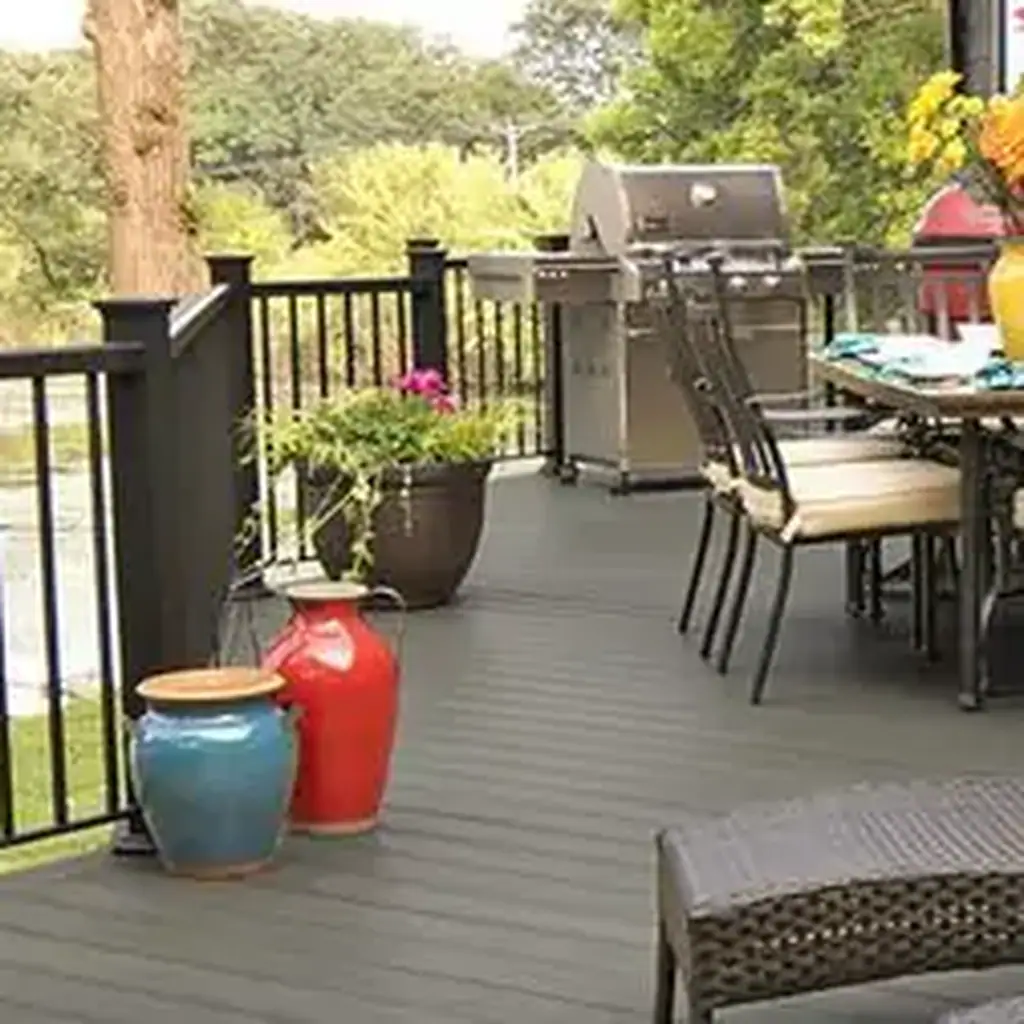
2. Commercial & Residential Product Recommendations
Selecting the optimal Composite Decking profile requires balancing structural load capacities, fire-retardant ratings, slip resistance coefficients, and long-term life-cycle costs. Based on extensive field testing, contractor feedback, and laboratory degradation metrics, we recommend four primary material profiles:
Capped HDPE Composite Planks
Engineered for high-volume residential developments and multi-family amenities. Features a high-density polyethylene core encapsulated by a 360-degree acrylic polymer shield.
- Core Composition: 55% Recycled Wood / 45% HDPE
- Fade/Stain Warranty: 25–30 Years
- Flame Spread Index: Class B Rated
- Span Rating: 16" O.C. (100 psf)
AZEK® Cellular PVC Architectural Grade
100% synthetic, timber-free formulation designed for waterfront boardwalks, poolside docks, and luxury commercial dining terraces exposed to salt spray and heavy UV.
- Core Composition: Alloy Armour Technology™ PVC
- Fade/Stain Warranty: 50-Year Limited Lifetime
- Heat Retention: Up to 30°F Cooler (CoolTouch)
- Weight Reduction: 40% Lighter than Composite

TimberTech® PRO 4-Side Capped Series
Incorporates complete groove encapsulation to block moisture intrusion even within hidden fastener slots. Superior scratch resistance for high-traffic commercial venues.
- Core Composition: Reclaimed Wood & Polyolefin
- Fade/Stain Warranty: 30-Year Commercial
- Moisture Absorption: < 0.5% ASTM D1037
- Slip Resistance: Wet/Dry Exceeds ADA
3. Technological Evolution: Material Science Breakthroughs in Composite Decking
The composite decking industry has transitioned from early first-generation un-capped wood-plastic composite (WPC) formulations—which suffered from mold colonization, fiber swelling, and severe solar fading—to sophisticated, multi-layer co-extrusion polymer architectures.
3.1 Co-Extrusion & Multi-Shell Encapsulation
Modern premium composite planks utilize dual-stream co-extrusion processing. During manufacturing, the recycled wood-polymer core is continuously extruded under extreme pressure while simultaneously fused to an outer, non-porous fluoropolymer capstock. This cap layer contains concentrated ultraviolet (UV) stabilizers, hindered amine light stabilizers (HALS), and antimicrobial biocide compounds. By completely sealing organic wood fibers away from atmospheric humidity, modern co-extruded boards reduce water absorption rates to virtually non-measurable thresholds (<0.2% after 24-hour immersion).
3.2 Solar Reflective Index (SRI) & Surface Heat Mitigation
A primary historical complaint regarding synthetic decking was excessive surface heat retention under direct sunlight. Engineering advancements have introduced inorganic, heat-reflecting pigments into the outer capstock. These micro-pigments selectively reflect infrared spectrum radiation (700nm to 2500nm) while preserving dark, rich aesthetic tones such as Aged Walnut and Espresso. Test results demonstrate an SRI elevation from 18 in legacy composites to 42+ in modern cool-deck formulations, reducing bare-foot surface temperatures by 15°F to 30°F.
3.3 Digital Grain Embossing & Low-Gloss Surfacing
To eliminate the unnatural "plastic sheen" of early synthetic boards, manufacturers now employ multi-axis rotational calendering dies. Synchronized dual-color streaking and variable-depth wood grain embossing replicate natural hardwoods (such as Ipe, Teak, and Redwood) with zero repeating patterns over 20-foot spans. High-matte clear coats further scatter light rays, yielding an authentic matte timber appearance desired by architectural specifiers.
4. Future Global Procurement Trends (2026–2030)
Global procurement strategies for commercial building supplies are undergoing a paradigm shift. Enterprise buyers are moving away from short-sighted initial purchase cost analysis toward holistic Life Cycle Cost Analysis (LCCA) and rigorous Environmental, Social, and Governance (ESG) compliance auditing.
4.1 Total Cost of Ownership (TCO) vs. Pressure-Treated Lumber
While pressure-treated Southern Yellow Pine carries a lower initial material expenditure ($1.50 to $2.20 per lineal foot vs. $3.50 to $7.00 for mid-grade Composite Decking), its operational maintenance overhead is substantial. Real wood requires bi-annual power washing, sanding, restaining, and board replacement due to checking, cupping, and rot. Over a 20-year operational lifecycle, composite decking delivers an estimated 62% reduction in net maintenance costs, yielding full capital payback by Year 6 of installation.
4.2 Closed-Loop Circularity & LEED Certification Credits
Corporate ESG mandates require commercial developers to specify low-carbon, highly recycled building products. Industry leaders in composite decking divert millions of pounds of post-consumer plastic film (grocery bags, stretch wrap) and post-industrial wood sawdust from landfills annually. Premium composite formulations contain up to 95% recycled material by weight. Specifying these systems allows architects to claim critical points under LEED v4.1 Building Design and Construction within the Materials and Resources (MR) categories for Recycled Content and Environmental Product Declarations (EPDs).
4.3 Supply Chain Resilience & Freight Consolidation
International maritime shipping disruptions have exposed vulnerabilities in imported exotic hardwood supplies (Ipe, Cumaru). As rainforest harvesting restrictions tighten worldwide, global developers are standardizing on domestic US-manufactured composite decking. Facilities like Building 9 in Medina, Ohio act as strategic regional distribution hubs—allowing contractors to consolidate framing lumber, fasteners, vinyl siding, and composite decking onto single-truck delivery loads, dramatically slashing freight logistics expenses.
5. Technical Evaluation Matrix: Composite vs. Alternative Materials
The following comparative matrix outlines key engineering parameters, performance standards, and cost benchmarks for structural decking materials, serving as a technical reference for project engineering teams:
| Performance Metric | Pressure-Treated Pine | Uncapped Composite (Legacy) | Capped Composite (HDPE) | Cellular PVC (AZEK) |
|---|---|---|---|---|
| Density (lbs/cu.ft) | 35 – 42 | 58 – 65 | 62 – 68 | 32 – 38 |
| Moisture Absorption (24h) | 15.0% – 25.0% | 3.0% – 7.0% | < 0.5% | < 0.05% |
| Coeff. of Thermal Expansion | Minimal (Hygroscopic) | 2.2 × 10⁻⁵ in/in/°F | 1.8 × 10⁻⁵ in/in/°F | 3.1 × 10⁻⁵ in/in/°F |
| Slip Resistance (ASTM C1028) | 0.50 (Slippery when wet) | 0.55 (Moderate) | 0.68 (High Traction) | 0.74 (Superior Traction) |
| Flame Spread Index (ASTM E84) | Class C (75–200) | Class C (75–200) | Class B or A Available | Class A (< 25 Rated) |
| Maintenance Frequency | Annual Stain/Sealing | Occasional Scrubbing | Soap & Water Wash | Rinse / Zero Sealers |
| Service Life Expectancy | 10 – 15 Years | 15 – 20 Years | 25 – 30+ Years | 50+ Years (Lifetime) |
| Average Cost / Lineal Ft | $1.80 – $2.50 | $2.80 – $3.50 | $4.00 – $6.50 | $6.80 – $10.50 |
6. Frequently Asked Questions (FAQ) for Global Procurement & Engineering Teams
Request Your Wholesale Composite Decking Quote
Partner with Building 9 for your upcoming residential development, commercial project, or retail inventory needs. Receive direct factory pricing, freight estimates, and technical specifications tailored to your structural requirements.