
1. Executive Overview: The 2026 Global Kitchen Countertops Landscape
The global market for Kitchen Countertops is experiencing a fundamental structural shift driven by evolving environmental regulations, advanced digital fabrication technology (such as 5-axis CNC waterjets), and changing commercial procurement models. For international purchasing directors, regional distributors, and large-scale multi-family building contractors, sourcing kitchen countertops requires balancing aesthetic appeal against rigorous mechanical parameters: flexural strength, Mohs scratch hardness, water absorption coefficients, and thermal shock resistance.
Historically dominated by standard natural granite and early-generation engineered quartz, modern procurement now encompasses zero-silica bio-resin surfaces, ultra-compact sintered stone slabs, low-porosity engineered quartz, high-pressure decorative laminates, and solid surface acrylics. Selecting the appropriate surface for high-volume residential developments or commercial hospitality projects necessitates deep technical scrutiny to prevent long-term field failures, warranty disputes, and supply chain bottlenecks.
Information Gain Insight: Silica Regulations & Material Evolution
With strict silica enforcement policies emerging across North America, Europe, and Australia (such as Australia’s 2024 ban on traditional high-silica engineered stone), global countertop manufacturers are pivoting to crystalline silica-free or low-silica (<10%) formulations utilizing recycled glass, feldspar, and bio-based resin binders. Sourcing teams must audit supplier raw material declarations to ensure compliance with OSHA standards and international occupational health guidelines before finalizing bulk container orders.
2. Technical Material Benchmarks: Comparing Slab Performance
To assist procurement managers in matching kitchen countertop materials to specific project specifications, the engineering table below details the physical and chemical properties of the primary countertop surfaces available through wholesale supply channels.
| Surface Type | Mohs Hardness | Water Absorption (%) | Flexural Strength (MPa) | Thermal Limit (°C) | Silica Content (%) | Best Commercial Application |
|---|---|---|---|---|---|---|
| Engineered Quartz | 6.5 – 7.0 | < 0.03% | 40 – 55 MPa | 150°C (302°F) | 5% – 90% (Varies) | Multi-Family Housing, High-End Residential |
| Sintered Stone / Porcelain | 7.0 – 8.0 | < 0.01% | 45 – 60 MPa | 400°C+ (752°F+) | 10% – 25% | Outdoor Kitchens, High-Traffic Commercial |
| Natural Granite | 6.0 – 7.0 | 0.2% – 0.5% | 12 – 22 MPa | 250°C (482°F) | 20% – 45% | Classic Remodeling, Heavy Duty Residential |
| Acrylic Solid Surface | 2.5 – 3.5 | < 0.10% | 35 – 48 MPa | 100°C (212°F) | 0% (Silica Free) | Healthcare, Corporate Office Pantries |
| Butcher Block (Hardwood) | 3.0 – 4.0 (Janka) | Requires Sealing | N/A (Anisotropic) | 120°C (248°F) | 0% | Rustic Residential, Accent Kitchen Islands |
When selecting countertops for volume applications, understanding these physical limits directly impacts lifetime maintenance costs. For instance, while engineered quartz exhibits superior impact resistance and non-porosity, its resin binder makes it susceptible to thermal shock if hot cookware is applied directly. Conversely, sintered stone slabs offer near-indestructible heat resistance but demand specialized diamond-blade cutting parameters during shop fabrication.
3. Top Product Recommendations for Global Sourcing & Procurement
Based on direct sales velocity, contractor feedback, and supply stability at Building 9, we recommend the following core product lines for current commercial projects and warehouse distribution:
Jumbo Calacatta Quartz Slabs
Book-matched 3200mm x 1600mm slabs in 20mm and 30mm thickness. Features dramatic grey veining on pure white backdrops. Ideal for full-height backsplashes and waterfall islands.
Send an Inquiry
Chippewa Stone Natural Granite
Pre-cut and custom-fabricated natural granite tops sourced directly through strategic quarry partners. Sealed with fluoropolymer penetrants for maximum stain resistance.
Send an Inquiry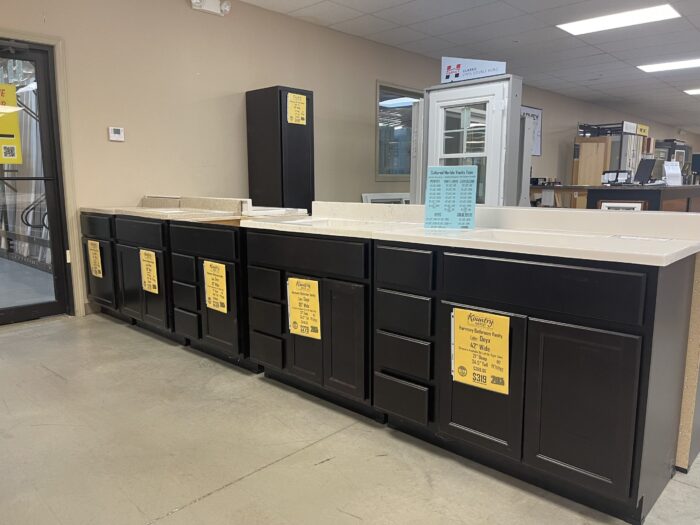
Special Buy Laminate & Solid Surface
High-yield inventory lots for apartment complexes, multi-family flips, and budget-conscious developments. In-stock and ready for immediate loading at our Medina distribution hub.
Send an Inquiry4. 2026–2030 Global Countertop Procurement & Industry Trends
Sourcing strategies are undergoing massive modernization. B2B purchasers must position their supply chains to accommodate three macro trends reshaping the kitchen countertop sector:
Trend 1: Demand for Ultra-Thin 12mm Sintered Porcelain Slabs
Architects and kitchen designers are increasingly specifying 12mm (approx. 1/2") thin-profile porcelain and sintered stone slabs for sleek, minimalist cabinetry designs. These slabs reduce freight tonnage per container by over 35% compared to traditional 30mm stone, offering substantial logistics savings while supporting vertical wall cladding without structural reinforcement.
Trend 2: Integrated Induction Cooking & Invisible Countertop Surfaces
The convergence of appliance technology and countertop manufacturing has given rise to through-slab induction cooking. Cooktops installed directly beneath porcelain or sintered stone surfaces allow home users to cook directly on the countertop. Procurement teams must source slabs verified for ultra-low thermal expansion and high flexural strength to handle localized thermal cycling.
Trend 3: Container Freight Optimization & Yield Calculations
With global maritime shipping rates subject to volatility, maximizing slab yield per 20-foot Full Container Load (FCL) is critical to preserving gross margins. Standard shipping parameters dictate strict payload weight limits (typically 21 to 27 metric tons depending on port restrictions):
- 20mm Slabs (Weight ~ 50 kg/m²): A standard 20ft container can hold approximately 400 – 450 m² of quartz (approx. 75–85 jumbo slabs packed on wooden A-frames).
- 30mm Slabs (Weight ~ 75 kg/m²): A standard 20ft container accommodates approximately 260 – 300 m² of quartz (approx. 50–58 jumbo slabs).
- 12mm Porcelain (Weight ~ 28 kg/m²): Freight weight limits allow over 700 m² of 12mm porcelain per container, drastically cutting landed cost per square foot.
5. Why Global Buyers & Regional Contractors Partner with Building 9
Founded in 1983 in Medina, Ohio, Building 9 has established itself over four decades as a premier stockist, regional distributor, and closeout liquidator of top-tier building materials. Our competitive advantage stems directly from our operational scale, supply chain relationships, and commitment to transparency.
Over 40 Years of Industry Expertise (Est. 1983)
Unlike transient online brokers, Building 9 has operated physical retail and distribution centers for over 40 years. Our team understands structural fabrication, cabinet box load capacities, countertop overhang cantilever limits, and local building code compliance. We serve general contractors, commercial property owners, independent kitchen fabricators, and DIY homeowners across Northeast Ohio and nationwide.
Massive On-Site Inventory & Factory Closeouts
Our Medina, Ohio facility maintains thousands of square feet of in-stock inventory including ready-to-ship kitchen cabinetry, countertop slabs, vanity tops, flooring, windows, doors, and vinyl siding. By procuring large-volume factory overruns, manufacturer closeouts, and direct container imports, we bypass conventional distributor markups to pass substantial savings directly to our buyers.
Contractor-First Service & Complete Logistics Support
We pride ourselves on providing a streamlined buying experience. From dedicated drive-through warehouse pickup lanes and load-out assistance to commercial freight coordination, Building 9 eliminates extended lead times. Projects requiring immediate material delivery rely on our quick-turn stock programs to keep job site schedules on track.
6. Global Procurement FAQ: Kitchen Countertops Sourcing Questions
Below are detailed technical responses to the most frequent inquiries submitted by global buyers, purchasing agents, and general contractors when sourcing kitchen countertops.
A: The choice between 20mm and 30mm slabs impacts aesthetics, structural requirements, and shipping economics:
- 30mm (3cm / ~1.18"): Preferred in North American residential design because it allows unsupported overhangs up to 10–12 inches on islands without sub-tops or plywood underlayment. It provides a substantial profile directly off the cabinet.
- 20mm (2cm / ~0.78"): Standard in European design and widely used in high-density multi-family builds. It requires a full plywood sub-top (underlayment) for strength and laminated edge miter profiles for visual height. However, 20mm slabs allow ~45% more surface area per shipping container, significantly lowering ocean freight costs per project unit.
A: Low-silica quartz (<10% crystalline silica) and zero-silica mineral surfaces utilize engineered matrices of recycled glass, crystalline feldspar, and specialized polymer resins. Mechanically, they meet or exceed standard quartz performance, offering Mohs hardness ratings of 6.5+, water absorption <0.05%, and identical stain resistance. Most importantly, they protect shop fabricators from occupational silicosis hazards and comply with emerging global safety mandates.
A: Safe cantilever overhang limits depend entirely on material elasticity and slab thickness:
- 30mm Quartz / Granite: Maximum 10 to 12 inches unsupported overhang. Beyond 12 inches, hidden steel corbels or support posts spaced every 24 inches are required.
- 20mm Quartz / Granite: Maximum 6 to 8 inches unsupported. Anything exceeding 8 inches mandates structural support brackets.
- 12mm Sintered Stone / Porcelain: Maximum 6 inches unsupported; island overhangs typically require continuous substrates or custom steel framing.
A: Building 9 offers end-to-end B2B supply assistance. We coordinate direct factory slab orders, pre-cut prefabricated tops for multi-family units, container loading, customs documentation, and regional freight transport. Whether you need 50 pre-cut vanity tops for an apartment project or 100 jumbo quartz slabs for custom fabrication, our Medina OH warehouse facility acts as your consolidation hub.
A: Sintered stone and porcelain slabs contain high internal tension. To prevent cracking during CNC processing, fabricators must: (1) Ensure the waterjet or saw table is perfectly level and clean of debris; (2) Perform stress-relief cuts along all four perimeter edges before cutting internal sink cutouts; (3) Use continuous-rim diamond blades specifically designed for ultracompact surfaces; and (4) Maintain adequate high-pressure water coolant at the cutting point.
A: In-stock inventory at Building 9’s Medina warehouse is available for immediate customer pickup or dispatch within 24 to 48 hours. Custom OEM container imports or factory-direct production runs typically require 6 to 10 weeks, accounting for slab pressing, polishing, sea freight transit, customs clearance, and final delivery.
7. Optimize Your Kitchen Countertop Supply Chain Today
Whether you are replacing residential countertops in Northeast Ohio or sourcing full container loads of engineered quartz for international project developments, Building 9 combines competitive pricing, high-grade material selection, and 40+ years of operational trust.
Contact our commercial sales desk today to request technical material datasheets, physical sample boxes, container yield optimization quotes, or current closeout inventory availability.