Building 9 Blog
Expert tips, renovation guides, and practical home improvement advice for your next project.
What Are the Best Carpet Squares for Commercial Use?
Table of Contents
- What Commercial Carpet Squares Are and How They Work
- Which Performance Features Matter Most in Commercial Spaces
- How Fiber, Backing, and Construction Affect Durability
- How to Match Carpet Squares to Different Commercial Settings
- What to Consider for Installation, Replacement, and Maintenance
- FAQS
- Conclusion
- Related Posts
Choosing the best Carpet Squares for commercial use is less about color alone and more about how a floor performs under daily stress. A hotel corridor faces rolling luggage and frequent cleaning. An office reception area must handle chair casters, grit, and sudden spills. The right tile balances wear resistance, stain protection, acoustic comfort, and straightforward replacement. Small details matter.
Industry evidence helps frame the decision. The Carpet and Rug Institute’s Carpet Maintenance Guidelines emphasize planned care, prompt spot cleaning, and suitable vacuuming—practical requirements for preserving appearance. The U.S. EPA’s Advancing Sustainable Materials Management report also tracks carpet and rug waste, making end-of-life planning relevant alongside purchase price. Ray Anderson, Interface’s founder and a longtime carpet-industry sustainability leader, put the broader materials challenge plainly: “There is no such thing as waste, only resources in the wrong place.” His principle is useful when comparing recycled content, take-back options, and service life, though product claims still need verification.
This guide examines construction, fiber, backing, installation, maintenance, and lifecycle value. It also distinguishes features that sound impressive from those that matter on a specification sheet. Check warranty terms, test results, and replacement availability. A beautiful sample is not a performance test. Some choices will still involve trade-offs: a lower upfront cost may mean more maintenance, while a premium tile may not suit every space. The best Carpet Squares are the ones that fit the building’s traffic, cleaning routine, and budget—and can be replaced without turning a small repair into a full-floor project.
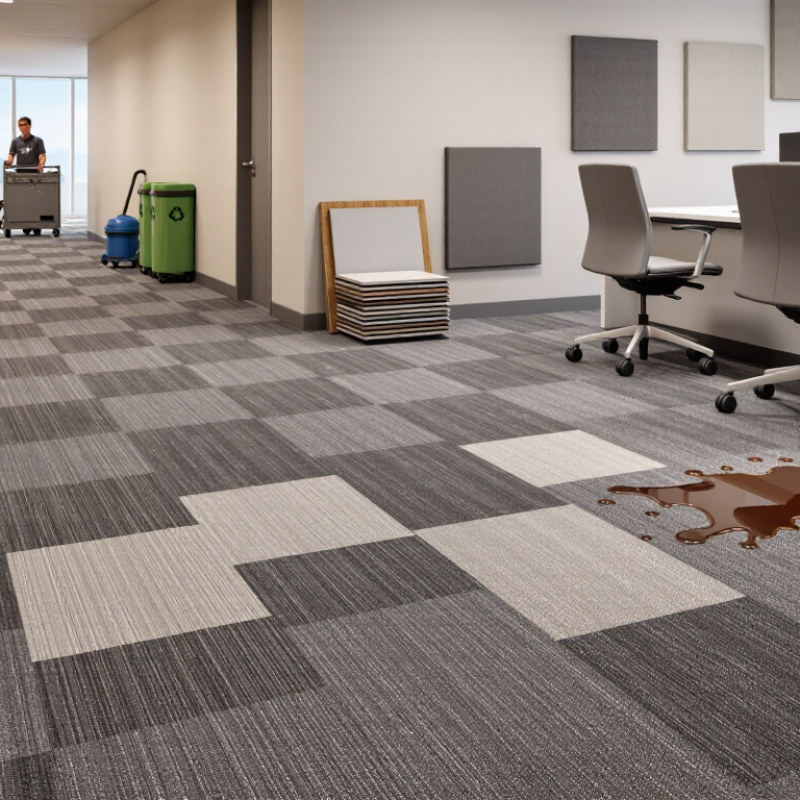
What Commercial Carpet Squares Are and How They Work
Commercial carpet squares, also called carpet tiles, are small, replaceable sections of carpet designed for busy indoor spaces. Most measure roughly 18 to 24 inches across, though sizes vary. A tile usually combines a carpet surface, a backing, and an edge that helps neighboring pieces sit evenly. The backing provides stability and may include cushioning. Installation can use adhesive, tackifier, or a loose-lay system, depending on the floor and product. The method matters. A poorly prepared concrete slab can undermine even a well-made tile.
Once installed, the tiles form a continuous walking surface, but each section remains separate. If coffee spills near a reception desk, a trained maintenance worker can lift the affected tile, clean or replace it, and return the area to service. Keep spare tiles from the same batch; dye and texture can vary between production runs. That small step helps. Directional arrows on the backing guide placement, allowing installers to create a consistent look or a planned pattern. Still, modular flooring is not automatically easy to maintain. Gaps, uneven subfloors, or incorrect adhesive can cause edges to lift. Measure the room, check the substrate, and confirm cleaning needs before choosing a tile system.
Which Performance Features Matter Most in Commercial Spaces
In commercial spaces, carpet squares need to handle rolling chairs, grit, spills, and repeated cleaning. Prioritize tested appearance retention, colorfastness, dimensional stability, and resistance to soil. ASTM D5252 uses a hexapod tumbler to assess changes in carpet appearance under controlled conditions. It offers useful comparisons, but cannot reproduce years of carts turning over the same corridor.
Maintenance matters just as much as initial durability. Look for tiles that can be lifted and replaced without disturbing a whole room, especially near entrances and coffee stations. The U.S. Environmental Protection Agency reports that construction and demolition activities generated 600 million tons of debris in 2018, with more than 90% coming from demolition. That figure covers many materials, not carpet alone, but it underscores why repairability deserves attention.
Check the backing and installation system for dimensional stability, secure seams, and compatibility with the cleaning methods staff actually use. Ask for test results, not just claims such as “heavy duty.” A dense surface can hide soil, yet still demand careful vacuuming. And a low-pile tile may roll smoothly under chairs but feel less forgiving underfoot. There is no perfect square; traffic patterns, cleaning capacity, and comfort can pull in different directions.
How Fiber, Backing, and Construction Affect Durability
Commercial carpet squares last when fiber, backing, and construction work together. Nylon often recovers better from crushed traffic lanes than polyester, while solution-dyed fibers can resist fading and many stains. But fiber labels alone do not predict service life. A dense, low-loop pile usually handles chair wheels better than a tall, soft pile.
Not the whole story. Ask for test results, not just face-weight figures.
ASTM D5252 evaluates carpet appearance retention with a Hexapod tester; ASTM D1335 measures tuft bind. These tests help compare products, but they do not recreate every building’s spills, grit, or rolling loads. Backing matters too: stable backing helps tiles stay flat, while compatible adhesive and moisture conditions reduce edge lift.
EPA’s 2018 Advancing Sustainable Materials Management report estimated 3.4 million U.S. tons of carpet and rugs were generated, with 9.2% recycled. That figure makes replacement frequency worth considering.
Before specifying, check test methods, installation requirements, and maintenance guidance against the site’s actual traffic. A showroom sample can look convincing; a busy entrance may tell a different story.
How to Match Carpet Squares to Different Commercial Settings
What Are the Best Carpet Squares for Commercial Use?
How to Match Carpet Squares to Different Commercial Settings
Match carpet squares to the work happening in each room. In open offices, low-loop tiles with dense construction handle rolling chairs and frequent foot traffic. Choose muted patterns to disguise small marks, and check that replacement tiles remain available. The U.S. Bureau of Labor Statistics recorded about 450,000 private-industry injury cases involving falls, slips, and trips in 2022. This figure is not specific to flooring, but it highlights why entrances need well-secured tiles and effective walk-off mats. Test it first.
Retail spaces and hotel corridors need tiles that tolerate repeated traffic and quick spot cleaning. A varied pattern can hide wear between scheduled cleans, while consistent dye lots help keep replacement areas from standing out. For classrooms and meeting rooms, consider denser underlay or acoustic backing to soften chair noise. Avoid carpet squares in persistently wet areas; moisture can compromise adhesion and create maintenance problems.
Think about replacement before installation. The U.S. Environmental Protection Agency’s 2018 materials report estimated that 3.4 million tons of carpet and rugs entered the U.S. waste stream, with about 14.7% recycled. Modular flooring can make localized repairs possible, but only if spare tiles are stored and crews can identify the original layout. That part is easy to overlook. A small on-site mock-up can reveal awkward seams, glare, or cleaning issues before the full floor is installed.
What Are the Best Carpet Squares for Commercial Use? - How to Match Carpet Squares to Different Commercial Settings
| Commercial Setting | Suitable Carpet-Square Construction | Fiber and Surface | Useful Design Features | Care and Practical Considerations |
|---|---|---|---|---|
| Office corridors and reception areas | Dense, low-profile loop pile with a stable commercial backing | Commercial-grade nylon is a common choice for busy areas because it offers good resilience and abrasion resistance. | Subtle patterns, heathered colors, and multi-directional layouts can help disguise everyday soil and reduce the appearance of seams. | Vacuum frequently and use walk-off mats at entrances. Keep replacement tiles from the same dye lot where possible for a closer color match. |
| Private offices and meeting rooms | Low loop or low, dense cut pile suited to rolling chairs | Nylon or solution-dyed polyester may suit moderate traffic; select a surface that resists snagging and chair-wheel wear. | Neutral colors and restrained patterns work well in professional spaces. Check that the specified chair casters are suitable for carpet. | Use chair mats where needed and inspect areas around desks, doorways, and furniture legs for concentrated wear. |
| Retail floors and customer service areas | Dense, low loop pile designed for frequent foot traffic | Nylon is often selected for resilience; solution-dyed fibers can offer improved resistance to color fading from cleaning and light exposure. | Choose a pattern and color that coordinate with the interior while making small marks less noticeable. Confirm suitability for the expected traffic level. | Plan for prompt spot cleaning and regular vacuuming. Modular tiles make localized replacement possible when individual sections are damaged. |
| Restaurants and food-service areas | Carpet squares only in dry, lower-risk zones such as offices or dining areas where carpet is permitted | A low-profile, stain-resistant commercial surface is easier to maintain than a deep or textured pile. | Use darker or patterned designs to reduce the visibility of minor marks; select products with documented cleaning instructions. | Carpet is generally less suitable near cooking lines, dishwashing stations, and areas exposed to frequent spills. Follow local health and safety requirements. |
| Education and training spaces | Durable, low loop pile with a backing appropriate for the subfloor and installation method | Commercial nylon or polypropylene options are available; compare wear, stain, and cleaning specifications rather than relying on fiber type alone. | Patterned tiles can define zones or create wayfinding cues. Use colors that remain legible under the room’s lighting. | Keep a small quantity of spare tiles for repairs. Check cleaning compatibility and consider noise, moisture, and furniture movement in the room. |
| Healthcare and care facilities | Low-profile, dense construction in areas where carpet is allowed by facility policy | Select a product with clearly stated maintenance, emissions, and performance documentation appropriate to the project. | Contrasting patterns may support visual zoning, but avoid designs that could be confusing for people with visual or cognitive impairments. | Confirm infection-control, accessibility, rolling-load, and cleaning requirements with the facility team before specifying carpet. Hard flooring may be required in some zones. |
| Hospitality guest rooms and lounges | Soft, dense pile for comfort in rooms; durable low loop for shared lounges | Nylon and other commercial fibers are available in a range of textures; choose according to traffic, appearance, and maintenance needs. | Use coordinated colors or patterns to create a welcoming look while allowing individual tiles to be replaced if stained or damaged. | Review the manufacturer’s cleaning guidance and the project’s fire, accessibility, and indoor-air-quality requirements before installation. |
Selection note: Product performance varies by construction, backing, installation, and maintenance. Compare published specifications for traffic classification, dimensional stability, stain treatment, indoor-air-quality testing, and warranty conditions, and verify that the chosen tile is compatible with the subfloor and adhesive or installation system.
What to Consider for Installation, Replacement, and Maintenance
Commercial carpet squares are useful in busy offices because damaged sections can be replaced without removing an entire floor. Installation quality still matters. The subfloor should be clean, dry, and level; dust or old adhesive can cause edges to lift. Check moisture before laying tiles, especially on concrete. Small problems grow.
Plan the layout around doorways, corridors, and desk clusters. A dry fit helps prevent narrow slivers along walls and keeps seams away from the heaviest traffic when possible. Follow the tile maker’s specified adhesive and placement method, since some systems need pressure-sensitive adhesive while others use different approaches. Keep spare tiles from the same production lot for future repairs. Color can vary between lots, even when the shade name matches.
For replacement, lift a damaged tile carefully and remove loose adhesive without gouging the floor. Fit the new piece in the same direction as its neighbors; directional patterns can look patchy when rotated. Vacuum regularly, and promptly blot spills with a clean cloth rather than scrubbing them deeper into the pile. Use cleaning products approved for the flooring, and test them in an inconspicuous spot. Maintenance schedules should reflect actual foot traffic, not just a calendar. That distinction is easy to overlook. One weak point: frequent deep cleaning may not fix worn fibers, so inspect tiles before treating every dull area as a cleaning problem.
FAQS
They are separate carpet sections, often 18 to 24 inches wide, installed together as one walking surface. Each tile has a carpet face and backing. Sizes vary.
Depending on the floor and product, installers may use adhesive, tackifier, or a loose-lay system. The subfloor matters. Uneven concrete can cause trouble.
Low-loop tiles with dense construction can handle rolling chairs and frequent foot traffic. Muted patterns may disguise small marks. They will not hide everything.
Often, yes. A maintenance worker can lift, clean, or replace the affected tile. Keep spare tiles from the same production batch for a closer match.
Avoid using them where moisture persists. Water can weaken adhesion and create ongoing maintenance problems. A quick fix may not last.
Use well-secured tiles and effective walk-off mats to help manage tracked-in dirt and moisture. Check tile edges regularly. Small details matter.
Measure the room, inspect the subfloor, and confirm cleaning needs. Check backing arrows and plan the tile direction. It is easy to overlook this.
A test area can reveal awkward seams, glare, or cleaning issues before the full floor is installed. It may also help assess chair noise. Worth the extra step.
Conclusion
Commercial carpet squares are modular flooring pieces designed to handle the demands of busy workplaces. Their individual format makes it possible to combine patterns, replace worn or damaged sections, and adapt flooring to different room layouts. When choosing Carpet Squares, consider performance features such as resistance to stains, wear, moisture, and fading, along with comfort, sound absorption, and ease of cleaning.
Durability depends on how the fiber, backing, and overall construction work together. The right combination may vary by setting: offices, corridors, retail areas, and hospitality spaces experience different levels of traffic and require different looks and maintenance routines. Before installation, assess the subfloor, layout, and fitting method. Regular vacuuming and prompt spot cleaning help preserve appearance, while the modular design can simplify targeted repairs and replacements over time.

Blog Tags: