Ideas & Inspiration

Building 9 Blog

Expert tips, renovation guides, and practical home improvement advice for your next project.

0%

Choosing Kitchen Faucets and Sinks is not merely a matter of matching finishes. It affects water use, cleaning habits, countertop space, and daily comfort. The National Kitchen & Bath Association’s 2024 Kitchen Trends Report identifies functional planning and durable materials as continuing priorities in kitchen projects. That advice feels practical beside a real sink, where a heavy pan can quickly expose weak design decisions.

Industry data also shows why measurements matter. Houzz’s 2024 U.S. Kitchen Trends Study reports strong homeowner interest in upgraded kitchen features, including improved storage, larger work areas, and more convenient fixtures. However, preference data is not a universal rule. A deep workstation sink may suit a large family, yet overwhelm a compact kitchen. A pull-down faucet may look efficient, but its reach can splash a shallow basin.

Performance deserves equal attention. The U.S. Environmental Protection Agency recommends checking efficient water fixtures through its WaterSense program, although WaterSense coverage does not apply equally to every kitchen faucet category. Buyers should also review the faucet’s flow rate, warranty, cartridge quality, and compliance with ASME A112.18.1/CSA B125.1 standards. Small details matter. Measure twice.

This guide compares sink materials, bowl configurations, mounting styles, faucet heights, spray functions, and installation requirements. It also considers cleaning effort, household routines, and long-term repair access. The best choice is rarely the most expensive model. It is the one that fits the user, the cabinet, and the plumbing without forcing daily compromises. Truthfully, even careful selection can miss something. Kitchens reveal those mistakes quickly.
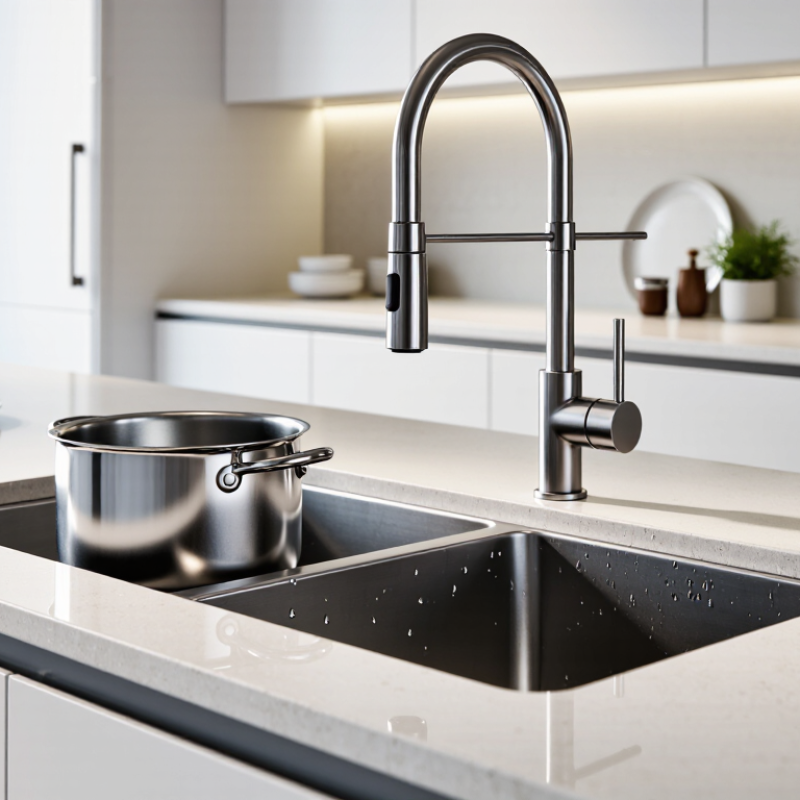
How to Choose Kitchen Faucets and Sinks for Your Home?

Assess Kitchen Tasks, Layout, and Household Water-Use Needs

Choosing a kitchen faucet and sink starts with real household tasks, not showroom appearance. Count how often you rinse vegetables, fill tall pots, wash baking trays, or hand-wash dishes. A deep single bowl handles large cookware well. Two bowls separate soaking from rinsing. That sounds obvious. Still, many homeowners choose a basin that looks spacious but cannot fit their largest pan.

Study the layout before selecting a faucet. Measure cabinet width, countertop depth, window clearance, and the dishwasher’s position. The faucet should reach the main washing zone without spraying across the counter. A pull-down design can help with flexible rinsing, while a compact model may suit a narrow galley kitchen. Check the handle position, too. A side handle near a wall can become frustrating. I have seen attractive installations lose useful workspace because the spout collided with a window frame.

Water use deserves equal attention. The Water Research Foundation’s Residential End Uses of Water, Version 2, reports that faucets account for about 19% of indoor household water use. For comparison, U.S. EPA WaterSense criteria limit labeled bathroom faucets to 1.5 gallons per minute, compared with the federal 2.2-gallon standard. Kitchen fixtures may follow different requirements, so verify the specification sheet. Choose an aerated flow for everyday rinsing, but avoid assuming lower flow always feels better. A weak stream can increase running time. That trade-off needs reconsideration.

Compare Faucet Flow Rates: 2.2 GPM Federal Limit vs. 1.5 GPM WaterSense

When choosing kitchen faucets and sinks, compare flow rate before finish, height, or pull-down reach. In the United States, the federal maximum for residential kitchen faucets is 2.2 gallons per minute (GPM) at 60 psi, according to the U.S. Department of Energy’s appliance standards. That figure is a ceiling, not a performance target.

The 1.5 GPM WaterSense figure needs careful interpretation. The U.S. Environmental Protection Agency’s WaterSense faucet specification applies mainly to bathroom lavatory faucets, where certified models use no more than 1.5 GPM. EPA reports that these faucets can use at least 30% less water than standard 2.2 GPM models. It should not be treated as a universal kitchen-faucet rule. Kitchen tasks often need stronger rinsing performance, especially with baked-on food and deep cookware.

Test the sink in real use. Fill a 4-quart pot and watch whether the stream feels controlled or frustratingly weak. A lower-flow faucet may save water, but long rinsing can cancel part of that benefit. The U.S. Geological Survey’s residential water-use research also shows that daily household demand varies widely by behavior and fixture use. Choose a faucet with a measured flow near your needs, then match it with a basin deep enough to reduce splashing. I would not choose 2.2 GPM automatically. Nor would I assume 1.5 GPM is always better.

Select Sink Size, Bowl Configuration, and Minimum Cabinet Dimensions

How to Choose Kitchen Faucets and Sinks for Your Home?

Sink size should match your cabinet, cooking habits, and available counter space. Measure the cabinet’s internal width, not only its outside face. A 30-inch sink may need a 33-inch cabinet, depending on its rim, rails, and mounting method. Check the installation template before ordering. It prevents an expensive countertop mistake.

Choose the bowl configuration around your daily work. A deep single bowl handles roasting pans and large cutting boards with fewer interruptions. A double bowl supports washing and rinsing, but each compartment becomes smaller. Bowl depth also matters. Very deep sinks can strain your back and may reduce storage below. I once chose depth over comfort, and the lower cabinet became awkward to use. That decision still seems imperfect.

Tips: Leave room beside the sink for landing areas. Confirm the faucet hole pattern and plumbing location. Open cabinet doors during measurement. Check clearance for waste pipes and water lines. If several people cook together, a wider single bowl may improve movement. For small kitchens, a compact bowl can protect valuable counter space. Always compare the sink’s minimum cabinet requirement with your actual cabinet frame, because advertised dimensions can hide structural limits.

Check Material Durability, Corrosion Resistance, and Installation Standards

Material choice affects both service life and drinking-water safety. Stainless steel resists rust well, especially in humid kitchens. Grade 304 suits most homes, while 316 offers better resistance near coastal air. Solid brass can perform reliably, but its alloy and finish need verification. Do not trust appearance alone. NSF/ANSI/CAN 61 certification helps confirm that wetted components meet health-based requirements for drinking-water contact.

Corrosion often begins around hidden threads, cartridge seals, and hose connections. Look for smooth plating, reinforced braided hoses, and replaceable ceramic cartridges. A 2016 Water Research Foundation study, Residential End Uses of Water, found faucets account for about 15.7% of indoor household water use. Small leaks can therefore waste more than expected. Check the technical sheet for flow rate, pressure range, and temperature limits. Kitchen fittings face frequent shock from hot pans and cleaning chemicals.

Installation standards matter as much as metal quality. Select a faucet matching the sink’s hole spacing and mounting thickness. Confirm compliance with ASME A112.18.1/CSA B125.1, where applicable. Use approved connectors, avoid overtightening, and flush supply lines before opening the valve. Poor alignment can stress the cartridge and create slow leaks. A common mistake is choosing a heavy faucet for a thin sink without a support plate. It may feel solid at first. It can loosen later. Inspect the underside after several weeks, because hidden moisture is easy to miss.

Verify Faucet Reach, Mounting Compatibility, and ADA 5-Pound Controls

How to Choose Kitchen Faucets and Sinks for Your Home?

A faucet can look right and still fail in daily use. Measure the spout reach before ordering. The water stream should land near the sink’s center, not against the front wall. A shallow sink may need shorter reach. A deep, divided sink may need a longer one.

Check the faucet hole pattern, too. Single-hole, three-hole, and wall-mounted designs are not interchangeable without extra parts. The National Kitchen and Bath Association’s kitchen research continues to identify improved functionality as a major remodeling priority. That supports careful measuring, not purely decorative selection.

Accessibility requires more than a lever handle. The 2010 ADA Standards specify that operable parts must require no more than five pounds of force. They should work with one hand, without tight grasping, pinching, or twisting. The standards also define reach limits, including a 48-inch maximum forward reach in applicable conditions.

Test the control with a wet hand. It should move smoothly, without slipping or sudden resistance. I would not trust a product description alone.

Water use deserves a second check. The U.S. Environmental Protection Agency states that WaterSense bathroom faucets use no more than 1.5 gallons per minute, compared with the federal 2.2-gpm standard. Kitchen faucet ratings can differ, so verify the actual specification.

A pull-down hose may stretch farther than expected, but it can also drag across the basin. That small detail is easy to miss. Consult the installation sheet and local accessibility requirements before cutting the countertop.

FAQS

What is the federal maximum flow rate for a residential kitchen faucet?

The federal maximum is 2.2 gallons per minute at 60 psi. It is a ceiling, not a target.

Is a 1.5 GPM faucet always better than a 2.2 GPM faucet?

Not always. Lower flow can save water, but weak rinsing may extend washing time.

How can I test whether a faucet’s flow feels practical?

Fill a four-quart pot at the sink. Watch the stream and notice whether rinsing feels controlled or frustrating.

Why might kitchen tasks need more flow?

Baked-on food and deep cookware may need stronger rinsing. A very gentle stream can feel slow.

Can long rinsing reduce the benefit of a low-flow faucet?

Yes. Extra rinsing time may cancel part of the water savings. The result depends on daily habits.

How should I choose a sink size?

Match the sink to your cabinet, cooking habits, and counter space. Measure the cabinet’s inside width.

What cabinet size might a 30-inch sink require?

A 30-inch sink may need a 33-inch cabinet. Rims, rails, and mounting methods can change the requirement.

Should I choose a single bowl or a double bowl?

A deep single bowl fits roasting pans and large boards. A double bowl separates washing and rinsing, but each side is smaller.

What problems can an overly deep sink cause?

It may strain your back and reduce storage below. I once chose depth over comfort, and the cabinet became awkward.

What should I check before ordering a sink?

Review the installation template, faucet holes, plumbing position, and cabinet-door clearance. Leave landing space beside the basin.

Conclusion

Choosing Kitchen Faucets and Sinks starts with understanding how your household uses the kitchen. Consider whether you regularly wash large cookware, prepare food, fill containers, or need flexible spray functions. Review the available layout, counter space, plumbing position, and daily water-use habits before selecting a faucet or sink. Faucet flow rates also deserve attention: the federal maximum is generally 2.2 gallons per minute, while WaterSense-labeled options use no more than 1.5 gallons per minute under qualifying standards, helping reduce water consumption without sacrificing practical performance.

For the sink, match the size and bowl configuration to your tasks and confirm that the cabinet provides the required minimum dimensions. Evaluate materials for durability, corrosion resistance, ease of cleaning, and compatibility with accepted installation standards. Before purchasing a faucet, measure its reach and height, confirm that the mounting style fits the sink or countertop, and check clearance around walls and backsplashes. Controls should also be easy to operate; for accessible installations, ADA guidance includes controls that can be operated with no more than five pounds of force.

Isabella

Isabella

Isabella is a dedicated professional marketer with a deep understanding of the company's products and services. With a passion for driving engagement and building brand awareness, she plays a crucial role in our marketing team. Isabella's expertise in the industry ensures that she is always......